What is an escape room? The full guide
An escape room is a room where you and your group get locked in and have to get out by solving puzzles and clues within a set time, usually 60 minutes. You hunt for clues, put them together and open locks. Easy to grasp. Tricky to beat. And surprisingly addictive.
Here we cover the lot: where it came from, how it works, the types out there, how you actually beat a room, and who it suits. Read to the end and you'll be ready for your first game.
Where do escape rooms come from?
The idea is younger than most people think. The first real escape room opened in Japan in 2007. A guy named Takao Kato, who ran a company called SCRAP, was watching a computer game where you clicked around a virtual room to find clues and get out. He thought: what if you could do that for real?
So he built one. Real Escape Game, for teams of 5–6 people. And he made it brutally hard on purpose. At the launch, only 6 of 150 players made it out. It became a talking point straight away. The format spread fast across Asia, then to the US and Europe, and today escape rooms are pretty much everywhere.
The roots go back even further, to text and point-and-click games. Back in the 1970s there were games like Colossal Cave Adventure, where the whole point was solving riddles to find your way out of a cave. Escape rooms took that feeling and moved it into a physical room.
How an escape room works
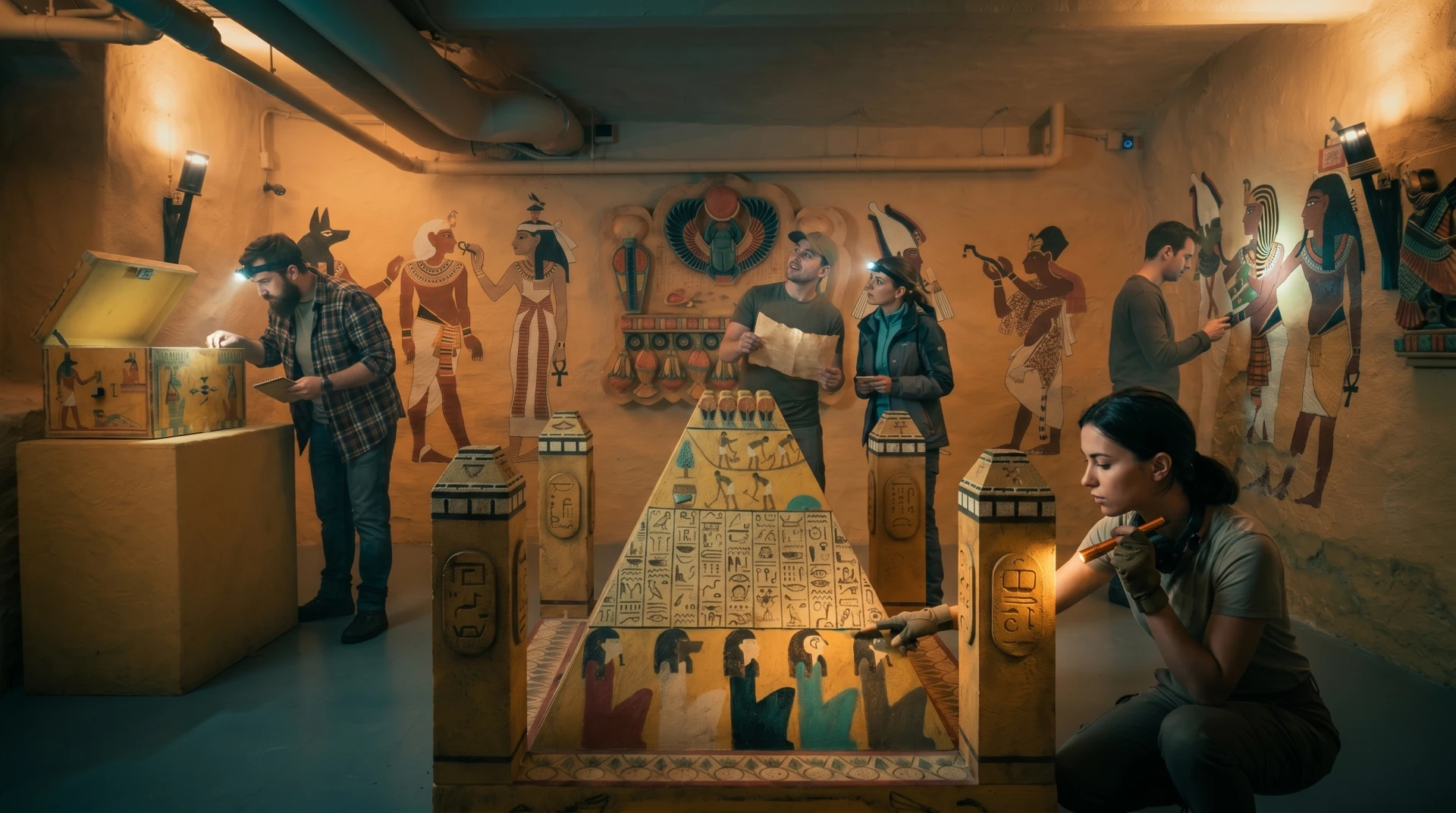
You step into a themed room. Maybe a bank vault, an old pyramid or a lab. The door closes. A clock starts counting down from 60 minutes. From there it's up to you.
You search the room, find clues and work out how it all connects. A code here opens a lock there. An object you find fits into something else. Every puzzle you crack gets you one step closer to the exit. Get stuck and we're there to give you a nudge. And no, nobody actually stays locked in.
Different types of escape room
Not every room is built the same way. Broadly, there are two setups:
- Linear rooms — you solve one puzzle at a time, in a set order. Each solved puzzle hands you the next. Great for beginners, because you're always on the same track.
- Non-linear rooms — several puzzles are open at once and can be solved in parallel. You can split up and work on different things. These suit bigger groups well.
Plenty of rooms mix the two. And the puzzles themselves vary: codes and ciphers, logic puzzles, things to find and combine, sometimes a physical task. Watch out for red herrings too — fake clues that are only there to throw you off. They're part of the game.
So what do you actually do in there?
- Look for hidden clues and objects, high and low.
- Solve puzzles, codes and locks.
- Piece it all together into the bigger picture.
- Talk and work together the whole time.
You don't need to be an expert. You don't need to run or be fit. Just bring some curiosity and a bit of patience for puzzles.
Tips to beat the room
Want to actually get out in time? A few things that really help:
- Talk out loud. Find something, say it. The best teams aren't the fastest, they talk the most.
- Search properly. Turn things over, look behind and under. Clues hide.
- Don't guess locks. Codes are almost never just lying around. Solve something first, don't try random numbers.
- Gather clues in one spot. Lay out what you've found so everyone sees the whole picture.
- Stuck? Ask for a hint. It's not cheating. If nothing new has happened in five minutes, take the help.
- Watch the clock. Let one person keep an eye on the time and what's left.
Who is it for?
Pretty much everyone. Your mates, your family, a date, a work kick-off, a stag or hen party. Our rooms fit 2 to 7 people, so it works for the two of you or a bigger crew. Kids too, as long as an adult is in the room.
Why are escape rooms so popular?
Because they hit something. It's genuinely social — you have to talk, think and solve things together, with no phones in your hands. It's a brain workout that doesn't feel like studying. And it gives you a shared thing to talk about long after. Beat it with 58 minutes on the clock? You'll remember that one.
Where can you try an escape room in Stockholm?
With us at Quezzle, right in the city on Döbelnsgatan 12, a couple of minutes from Rådmansgatan. We've got five rooms, each with its own theme and difficulty. Want to try your first escape room in Stockholm? Just pick a room and book a time. See you there!